

Retirement Planning
Roth Conversions in Retirement: What to Know Before You Convert
Fortitude Financial · Aug 18, 2026
A Roth conversion can save you on taxes in retirement, but timing and amount matter. Here is what to consider before converting your traditional IRA.
What Is a Roth Conversion?
Roth conversions are one of the most discussed and most misunderstood tools in retirement planning. Done well, they can save you tens of thousands of dollars in taxes over your lifetime. Done poorly, they can create a tax bill you were not expecting.
A Roth conversion is the process of moving money from a traditional IRA or 401(k) into a Roth IRA. The key difference between the two account types is when you pay taxes. With a traditional IRA, you get a tax deduction now but pay taxes on withdrawals in retirement. With a Roth IRA, you pay taxes on the money now, but all future growth and withdrawals are tax-free.
When you convert funds from traditional to Roth, you pay income taxes on the amount you convert in the year of the conversion. In exchange, that money and all its future growth become permanently tax-free. For the right person at the right time, this trade-off can be incredibly valuable.
Why People Convert in Retirement
You might assume Roth conversions are something you do during your working years, but many of the best conversion opportunities actually come after you retire. Here is why.
Once you stop working, your taxable income often drops significantly. You no longer have a salary, and you may not yet be taking required minimum distributions (RMDs) from your traditional accounts. This creates a window, often in your 60s, where your taxable income is relatively low. Converting traditional IRA funds to Roth during these low-income years allows you to fill up the lower tax brackets at a bargain rate.
Later, when RMDs kick in at age 73, your taxable income may jump higher, pushing you into brackets you could have avoided. Converting earlier at lower rates can save you a significant amount of money over the long run.
Key Factors to Consider Before Converting
A Roth conversion is not a one-size-fits-all strategy. Several factors determine whether it makes sense for you.
Your current tax bracket vs. your expected future tax bracket. If you expect to be in a higher tax bracket in retirement than you are now, converting makes more sense. If you expect to be in a lower bracket, it may not be worth it.
The five-year rule. Every Roth conversion has its own five-year clock. You must wait five years from the January 1 of the year you convert before withdrawing converted funds penalty-free. This matters most if you are converting later in life.
Medicare premiums. Converting a large amount can increase your modified adjusted gross income (MAGI), which may push you into a higher Medicare premium tier the following year. This is often overlooked but can add thousands of dollars in unexpected costs.
Market timing. Converting when your account values are down means you pay taxes on a smaller amount, and more of your future growth happens tax-free in the Roth. Some investors strategically convert during market downturns for this reason.
How Much Should You Convert?
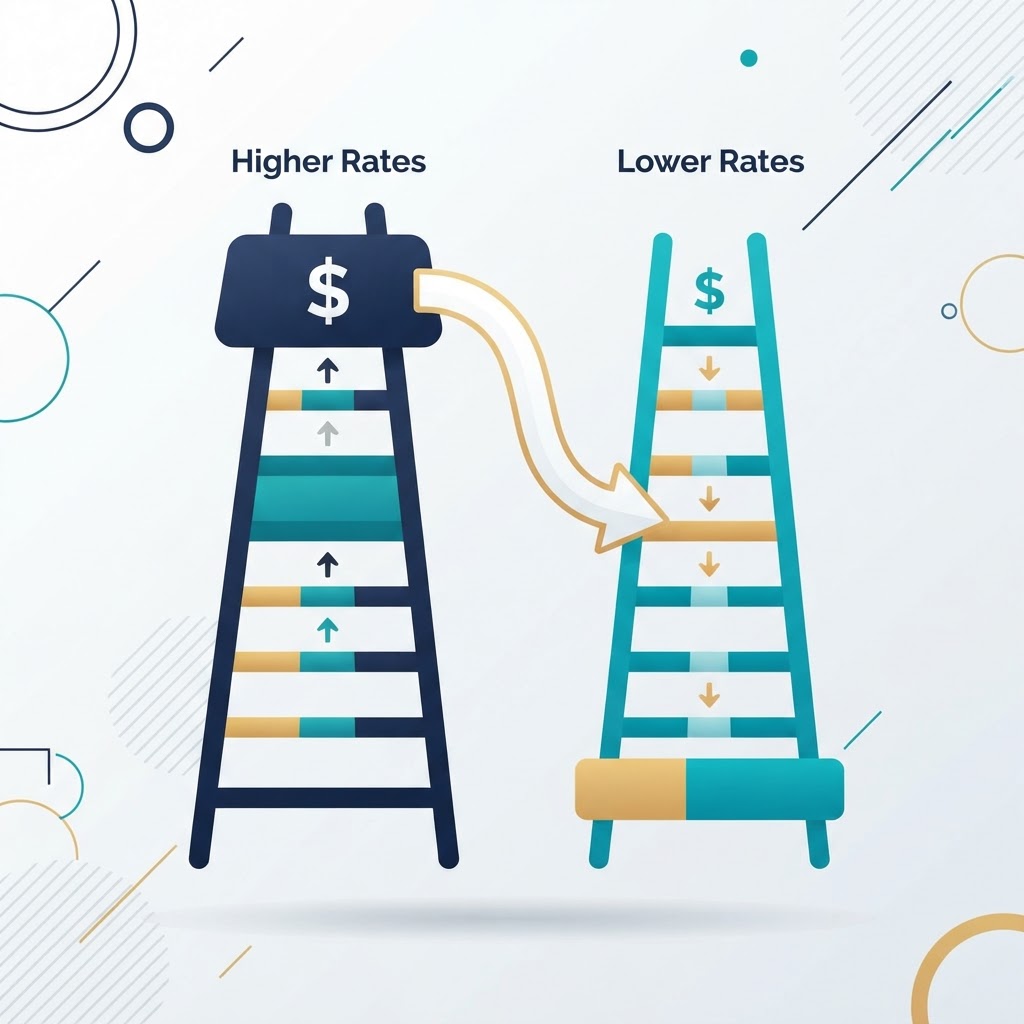
The ideal conversion amount fills up your current tax bracket without pushing you into the next one. For many retirees, this means converting enough to reach the top of the 12% or 22% bracket each year. This is sometimes called bracket filling.
For example, if you are in the 12% bracket and the next bracket starts at $48,000 of taxable income, and you currently have $30,000 of taxable income, you might convert $18,000 to fill the bracket. You pay 12% on that conversion now, lock in tax-free growth, and reduce future RMDs.
Some people also look at the gap between their current income and the top of the 0% capital gains bracket. If you can stay within that bracket, you may be able to convert funds while also selling investments at a 0% capital gains rate.
If you are charitably inclined, you can also pair conversions with qualified charitable distributions (QCDs) from your traditional IRA. A QCD satisfies your RMD without increasing your taxable income, while a separate conversion fills your bracket. The combination can be powerful for both tax efficiency and your giving goals.
The Estate Planning Angle
Roth IRAs have no RMDs during your lifetime, which means you can let the account grow tax-free for as long as you live. For estate planning purposes, this is a significant advantage. Your heirs can inherit a Roth IRA and take withdrawals over a ten-year period without paying income taxes on the growth.
By contrast, a traditional IRA inherited by your beneficiaries comes with both income taxes and a ten-year distribution requirement. Converting during your lifetime can reduce the tax burden on your heirs and simplify their inheritance significantly.
Common Mistakes to Avoid
Converting too much in one year. A large conversion can spike your tax bill, push you into a higher Medicare premium tier, and even affect your Social Security taxation. Spreading conversions across multiple years is usually smarter.
Forgetting about state taxes. Some states tax Roth conversions, others do not. If you live in a state with no income tax and plan to retire in one that does, converting before you move can be especially valuable.
Not having cash ready for the tax bill. The money to pay the conversion taxes should come from outside the IRA. If you withhold from the conversion itself to pay taxes, you reduce the amount growing tax-free and may also trigger penalties if you are under 59 and a half.
Ignoring the bigger picture. A Roth conversion is a tool, not a goal. It should fit into your overall retirement income plan, alongside Social Security, pensions, investment withdrawals, and estate planning considerations.
Is a Roth Conversion Right for You?
Roth conversions can be one of the most powerful tax-saving tools available in retirement, but they require careful planning. Your tax bracket, age, income needs, health care costs, and legacy goals all play a role in whether and how much to convert.
The best approach is to model different conversion scenarios, look at the tax impact over multiple years, and make adjustments as your situation changes. What works this year might not be optimal next year, so revisit your strategy annually.
Ready to take the next step? Schedule a free consultation with Fortitude Financial today, or explore our estate planning tool to get started.
Share this article