

retirement-planning
Social Security Claiming Strategies: How to Time Your Benefits for Maximum Lifetime Income
Fortitude Financial · Aug 18, 2026
Discover essential Social Security claiming strategies to maximize your lifetime income. Learn how timing your benefits impacts your overall long-term wealth.
Social Security remains one of the most vital foundations of a secure retirement strategy. For millions of Americans, these monthly benefits represent a guaranteed, inflation-adjusted income stream that lasts throughout their lifetimes. However, deciding precisely when to begin receiving your benefits is one of the most impactful financial choices you will make in your pre-retirement years. A misplaced decision can result in leaving tens or even hundreds of thousands of dollars on the table over the course of your retirement.
While many individuals opt to claim benefits as soon as they become eligible, taking a hasty approach can severely diminish your long-term payout. Understanding the underlying mechanics of Social Security claiming options empowers you to select a timeline that aligns with your personal health, financial needs, legacy goals, and broader wealth management strategy.
Understanding the Core Social Security Timeline: Ages 62, FRA, and 70
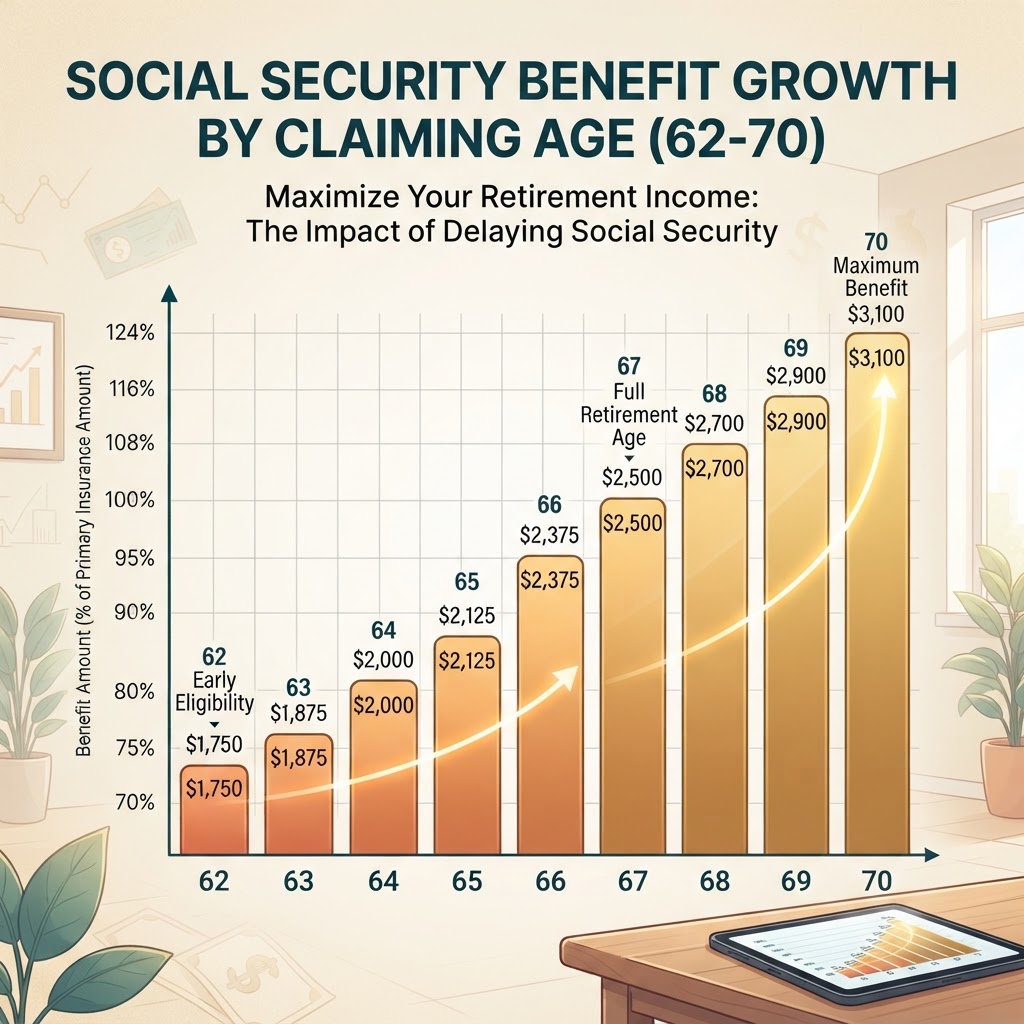
The timeline for claiming Social Security benefits revolves around three pivotal ages: 62, Full Retirement Age (FRA), and 70. You are first eligible to claim retired worker benefits at age 62. However, claiming early comes with a permanent reduction in your monthly benefit amount. For every year you claim prior to your Full Retirement Age, your monthly check is reduced by a set percentage. For instance, if your Full Retirement Age is 67 and you choose to file at age 62, your lifetime monthly payout will be permanently cut by up to 30 percent.
Full Retirement Age depends entirely on the year you were born. For individuals born in 1960 or later, Full Retirement Age is officially 67. Reaching your FRA entitles you to 100 percent of your calculated primary insurance amount (PIA), which is based on your highest 35 years of indexed earnings.
On the other end of the spectrum is age 70. For every year you delay claiming past your Full Retirement Age up until age 70, your benefit increases by approximately 8 percent per year through delayed retirement credits. This means that delaying from age 67 to age 70 yields a permanent 24 percent increase in your base monthly income. Because credits stop accumulating once you reach age 70, there is no financial advantage to delaying your claim beyond that milestone.
Evaluating the Financial Impact of Early vs. Delayed Claiming
To appreciate how dramatic the difference can be, consider a worker whose Primary Insurance Amount at age 67 is $2,000 per month. If this individual files at age 62, their starting benefit drops to $1,400 monthly. Conversely, if they wait until age 70, their monthly payout rises to $2,480. That represents a $1,080 monthly difference, or a 77 percent increase in recurring cash flow between filing early and waiting until age 70.
Over a retirement spanning 20 or 30 years, this compound difference becomes substantial. Furthermore, because cost-of-living adjustments (COLAs) are applied as a percentage of your baseline benefit, a higher starting benefit produces larger dollar increases every time inflation adjustments occur.
Spousal and Survivor Benefit Strategies for Couples
Married couples have unique tactical opportunities when structuring their Social Security claims. Spousal benefits allow one spouse to claim up to 50 percent of the other spouse's Primary Insurance Amount at Full Retirement Age, provided that worker has already filed for their own benefits. This can provide valuable income support, particularly in households where one partner earned significantly more than the other.
Survivor benefits are another crucial consideration in joint retirement planning. When one spouse passes away, the surviving spouse generally inherits the higher of the two monthly benefits, while the smaller benefit ceases. Consequently, the primary wage earner delaying their benefit until age 70 effectively maximizes not only their own retirement check, but also the protection provided to the surviving partner for the rest of their life.
Key Factors to Weigh When Customizing Your Claiming Strategy
Determining your ideal claiming age requires balancing multiple personal and financial variables rather than relying on a generic rule of thumb. Key considerations include:
- Health Status and Life Expectancy: If you have reason to anticipate a shorter life expectancy due to health concerns, claiming earlier may yield higher cumulative lifetime income. Conversely, if longevity runs in your family, delaying benefits often provides greater overall lifetime wealth.
- Current Cash Flow Needs: If you need Social Security income to meet essential living expenses or pay off high-interest debt, filing earlier may be necessary. If you have other income sources such as pensions or taxable accounts, bridging the gap to age 70 can be highly advantageous.
- Tax Implications: Up to 85 percent of your Social Security benefits may be subject to federal income tax depending on your combined provisional income. Integrating benefit timing with tax-bracket management, IRA distributions, and Roth conversions can preserve more of your total income.
- Continued Work: If you claim benefits before reaching Full Retirement Age and continue working, the Retirement Earnings Test may temporarily withhold a portion of your benefit if your wages exceed annual limits.
Integrating Social Security into a Comprehensive Financial Plan
Social Security should never be evaluated in isolation. Instead, it serves as one critical pillar within a broader wealth management and estate architecture. By coordinating your claiming timeline with portfolio withdrawals, tax optimization, and long-term care preparation, you can construct a resilient distribution strategy that withstands economic fluctuations.
Navigating the complex rules of Social Security can feel overwhelming, but you do not have to make these pivotal decisions alone. At Fortitude Financial, our dedicated team helps you evaluate your options and integrate claiming strategies into your overall retirement blueprint. To secure your financial future, schedule a personalized consultation with our team today. You can also explore our complimentary estate planning tool to ensure every aspect of your legacy is protected.
Share this article